
How Infused Pre-Rolls Are Made: Commercial Manufacturing Methods
THE INFUSED PREROLL MANUFACTURING SERIES — PART 1 OF 3
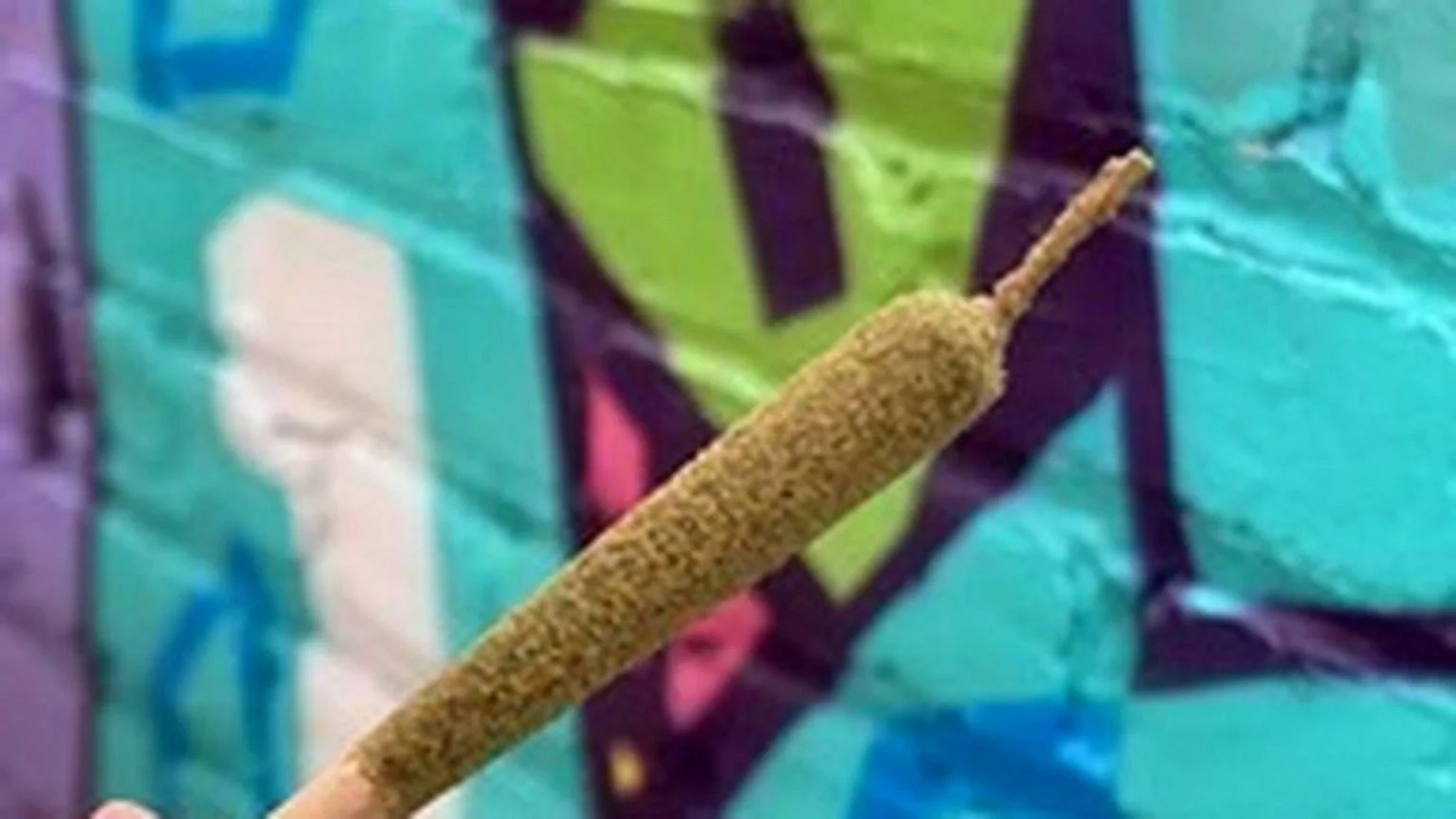
An infused pre-roll coated with concentrate and kief, one of several manufacturing approaches used in the infused preroll category.
The Rise of Infused Prerolls
If you’re wondering how infused prerolls are made , the answer starts with understanding how much the category has evolved. Walk into almost any dispensary today and you’ll find an entire section dedicated to infused pre-rolls. Some are coated with oil and kief. Others feature hash, live resin, live rosin, distillate, liquid diamonds, or proprietary concentrate blends that promise a stronger, more flavorful experience than flower alone. Many command two, three, or even four times the price of a traditional flower-only pre-roll, and consumers continue proving they’re willing to pay for products that deliver superior potency or a distinctly different experience.
What’s surprising is how little is generally understood about how infused prerolls are actually manufactured at scale.
The conversation often starts with a simple consumer question: What is the highest-potency preroll I can buy?
Budtenders explain the differences between distillate, live resin, live rosin, and diamonds. Marketing teams promote THC percentages, terpene profiles, and extraction methods. Those conversations matter, but they tell only a small part of the story. Behind every infused pre-roll sitting on a dispensary shelf is a production process that is significantly more complicated than most people realize.
That’s because an infused preroll isn’t simply flower with concentrate added to it. Infused preroll manufacturing creates an entirely different production challenge.
Every concentrate changes how flower behaves. Some formulations remain surprisingly dry and free-flowing, while others become heavier, stickier, or more cohesive. The same concentrate that creates a premium consumer experience can also become the reason production slows, cleaning increases, operators intervene more often, and manufacturing costs quietly begin climbing. Those are realities consumers rarely see because they happen long before the finished product reaches the dispensary.
How Infused Pre-Rolls Are Made at Commercial Scale
Spend enough time walking through cannabis manufacturing facilities and you’ll notice something else: no two companies seem to make infused pre-rolls exactly the same way.
Some manufacturers hand-mix dry or wet concentrates directly into the flower. Others inject concentrate after the pre-roll has been filled. Others coat the outside with oil before rolling it in kief, THCA, hash, or another cannabinoid-rich material. Every company believes its approach offers advantages, and in many cases they’re all right. Different manufacturing methods exist because different brands are trying to build different products for different consumers.
The book on how to infuse and produce at scale across this many concentrates has not been written yet.That simple observation explains why there has never been one standard way to manufacture infused pre-rolls. Instead, the industry has spent more than a decade experimenting with concentrates, recipes, equipment, and entirely new production workflows.
Before discussing production bottlenecks, preroll machines, infused preroll automation, or cannabis manufacturing equipment, it’s worth taking a step back to where much of the modern commercial category took root.
Los Angeles: The Roots of Modern Infused Preroll Manufacturing
People were adding hash and concentrates to joints long before anyone used the term “infused pre-roll.” Like many innovations in cannabis, the idea existed long before the industry figured out how to package it, brand it, manufacture it consistently, and put it on dispensary shelves.
But if you’re looking for the roots of the modern commercial infused pre-roll, Los Angeles deserves an important place in the story.
Long before California’s adult-use market opened in 2018, Los Angeles manufacturers were already experimenting with ways to combine flower, concentrates, hash, and kief into products that looked, smoked, and felt completely different from a traditional joint.
Caviar Gold, (Cavi Cone), was one of the early commercial pioneers. The company traces its proprietary cannabis infusion process to 2010, eventually building products like the Cavi Cone around flower, cannabis concentrate, and kief. Rather than treating concentrate simply as something applied to the outside of a finished joint, Caviar Gold helped commercialize the idea of making infusion part of the material and the product itself.
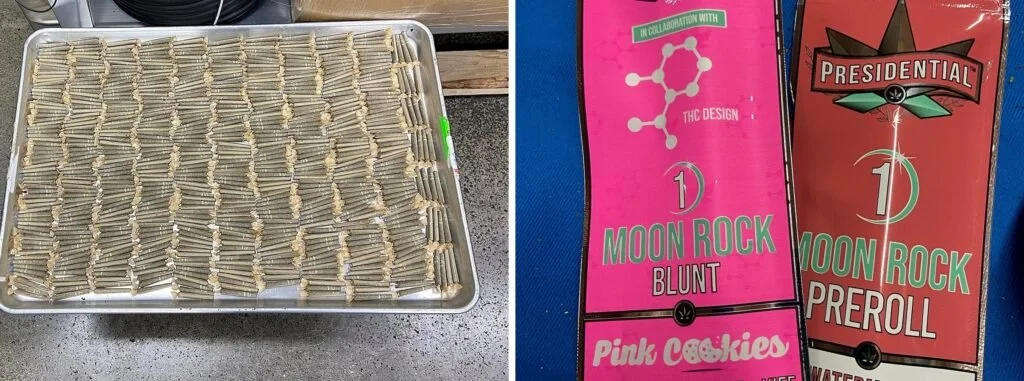
From early Moon Rock-style infused products to production at scale, infused preroll manufacturing has evolved significantly.
Presidential followed another distinctly Los Angeles path. Founded in LA in 2012, the company built its identity around Moon Rocks: cannabis flower combined with concentrate and coated in kief. The Moon Rock preroll concept eventually expanded into infused pre-rolls and tobacco-free blunts, demonstrating how flower, concentrate, and kief could become the foundation for an entire family of premium manufactured cannabis products.
Early Infused Preroll Pioneers
Meanwhile in the Bay Area came the Tarantula Preroll. By 2015, Ganja Gold’s Tarantula was taking infusion in another direction. Coating a joint with concentrate or adding kief wasn’t a new concept, but the Tarantula helped turn those ideas into a recognizable commercial product. Its construction brought together four components—flower, cannabis oil, hash, and kief—helping pioneer what today we might describe as a quad-infused pre-roll, an approach that has since become far more mainstream and is now most visibly represented by brands like Jeeter.
From a consumer’s perspective, Cavi Cones, Presidential Moon Rocks, and Tarantulas all belonged to the emerging world of infused weed and infused prerolls. From a manufacturing perspective, they were very different products, and that distinction matters.
These companies didn’t invent the idea of smoking flower and concentrates together. Cannabis consumers had been adding hash and other concentrates to joints for generations. What these early Los Angeles brands helped do was commercialize different approaches to infused cannabis, turning old ideas and new formulations into repeatable products that could be manufactured, packaged, branded, distributed, and eventually produced at increasingly larger scale.
How Infused Preroll Manufacturing Evolved
The concentrates have changed. The recipes have evolved. The category has become considerably more sophisticated, but many of the fundamental manufacturing philosophies—and manufacturing challenges—remain remarkably familiar.
Concentrate can become part of the flower before the pre-roll machine ever fills the cone. Manufacturers can apply concentrate after filling, inject or precisely dose it into a finished or partially finished product, or coat the outside. Increasingly, manufacturers combine multiple techniques to create products that don’t fit neatly into any single category.
Distillate became mainstream because of its potency and manufacturing consistency. Live resin opened new opportunities for brands focused on flavor and terpene preservation. Live rosin established a premium solventless category. Today manufacturers work with liquid diamonds, THCA, hash rosin, terpene blends, minor cannabinoids, and proprietary formulations that would have sounded exotic even to experienced operators a decade ago.
The ingredients keep changing, but the manufacturing challenge doesn’t.
Every new formulation eventually has to answer essentially the same question those early Los Angeles manufacturers were trying to solve: How do you combine flower and concentrate into a product consumers want—and then manufacture that product consistently enough to build a business around it?
That question is where the history of infused weed becomes the history of infused preroll manufacturing. It’s also where cannabis manufacturing starts getting complicated.
Internal Infusion: Where Material Science Meets Preroll Manufacturing
At its core, internal infusion means incorporating concentrates into the flower before the infused preroll is manufactured. The concept sounds straightforward, but that’s where the similarities usually end. Some manufacturers blend in dry kief, hash, or THCA crystalline to make kief-infused or THCA-infused prerolls while increasing potency. Others mix distillate or another highly viscous concentrate directly into flower. Premium brands may gravitate toward live resin or live rosin for live resin prerolls or live rosin prerolls when flavor, terpene preservation, or solventless positioning is central to the product.
We’ve been working with infused material for years, across virtually every major infusion type and many of the equipment and production methods used to manufacture it. We’ve worked with dry kief blends, distillate, live resin, live rosin, highly cohesive formulations, and proprietary processes that behave nothing like conventional ground flower.
THCA Infused Prerolls vs. Distillate: Two Very Different Materials
Not all internal infusion behaves the same way, and one of the biggest differences is whether you’re adding another dry particulate or trying to distribute a viscous concentrate throughout the flower.
THCA crystalline is one of the highest-potency cannabis concentrates available in a dry form. But ground flower is light and irregular while THCA crystals are hard and dense. During mixing, handling, and filling, those differences can cause separation, concentrated pockets, inconsistent density, and changes in airflow and burn.
Distillate and other high-potency viscous concentrates behave differently. When properly homogenized, the oil can coat the flower and become part of the flower matrix rather than remaining a separate particle within it. That can create a much more uniform infused material, but the challenge is getting it there consistently.
Scaling Internal Infusion for Commercial Production
Hand mixing is accessible and can produce large batches, but it is labor-intensive and consistency becomes harder to control as volume increases. Industrial mixing systems can create highly homogeneous infused batches, but production-scale equipment can start around $75,000.
At Hummingbird, we developed another approach designed to scale without requiring that level of equipment investment. Our internal infusion process uses extreme cold, including dry ice, to change how a viscous concentrate behaves during application. The process creates a fine dispersion across the flower, allowing the oil to coat substantially more surface area without creating the heavy, sticky pockets associated with traditional mixing. This style of infusion is still used by some of California’s largest infused preroll brands today.
Whether you’re producing THCA-infused prerolls, distillate-infused prerolls, or another internally infused product using hand mixing, cold-assisted infusion, or an industrial mixer, the manufacturing objective is the same: create a homogeneous material that remains consistent from the beginning of the batch to the end.
Viscous cannabis concentrates must be distributed consistently through flower to create a repeatable infused pre-roll.
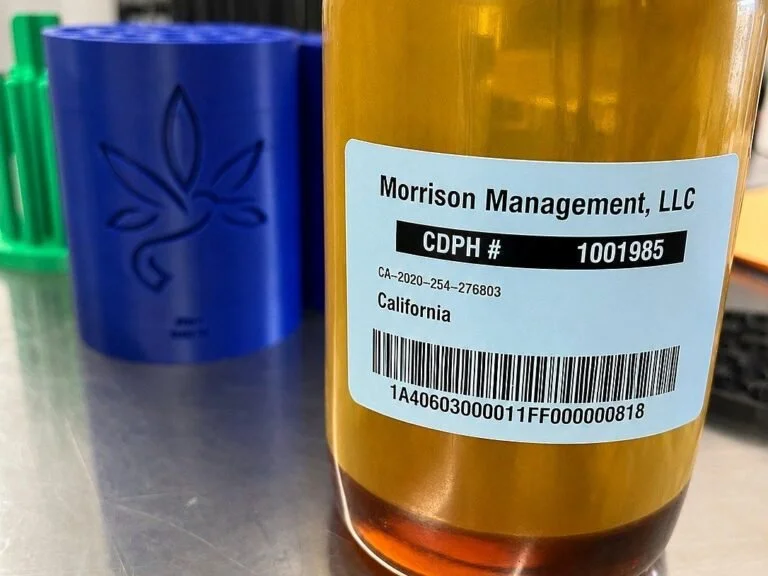
Viscous cannabis concentrates must be distributed consistently through flower to create a repeatable infused pre-roll.
What Controls Infused Preroll Consistency?
Even companies using the same concentrate can produce very different material by the time mixing is finished. Mixing time, temperature, moisture, concentrate ratio, and particle size all affect how the material ultimately behaves.
Some facilities use ribbon blenders. Others use paddle mixers, planetary mixers, high-shear systems, or proprietary processes refined over years of production. Those methods often become valuable intellectual property because they allow manufacturers to reproduce a product competitors struggle to duplicate.
That’s why experienced operators tend to smile when someone asks for the “best” infused recipe. There isn’t one. The recipe is only one piece of the manufacturing process; how that recipe behaves in production is often more important than how impressive it looks on paper.
The ingredients will keep changing. The infused preroll manufacturing objective does not: create a material that is consistent enough to reproduce at scale.
Equipment Used to Manufacture Infused Pre-Rolls at Scale
Once an infused product moves beyond small-batch development, the challenge changes. The question is no longer just how to infuse the material, but how to move that material through a repeatable production workflow without sacrificing consistency.
The equipment required depends heavily on the infusion method. Internally infused material may require different handling than injected products, core-style products, coated prerolls, or externally applied concentrates. Each method changes how the material fills, settles, compresses, and finishes.
At commercial scale, that usually means thinking about the entire line: flower preparation, filling, infusion or concentrate integration, tamping or settling, closing, finishing, and quality control. The goal is not to automate one isolated step. It is to build a workflow that can reproduce weight, density, concentrate distribution, and finished-product appearance across thousands of units.
That is where specialized preroll equipment becomes important. The right system has to match the material, the infusion method, the preroll format, and the production volume rather than forcing every infused product through the same process.
Part 2 is coming next: we’ll move downstream into injection, external coating, internally infused mixes, and the specialized preroll automation used to scale increasingly complex infused products.
In the meantime, download the Hummingbird Preroll Operator’s Guide for more on production readiness, equipment selection, workflow, and scaling preroll manufacturing.
