
More than a decade in preroll manufacturing has taught us something about production costs — and why we still don’t see more large multipacks.
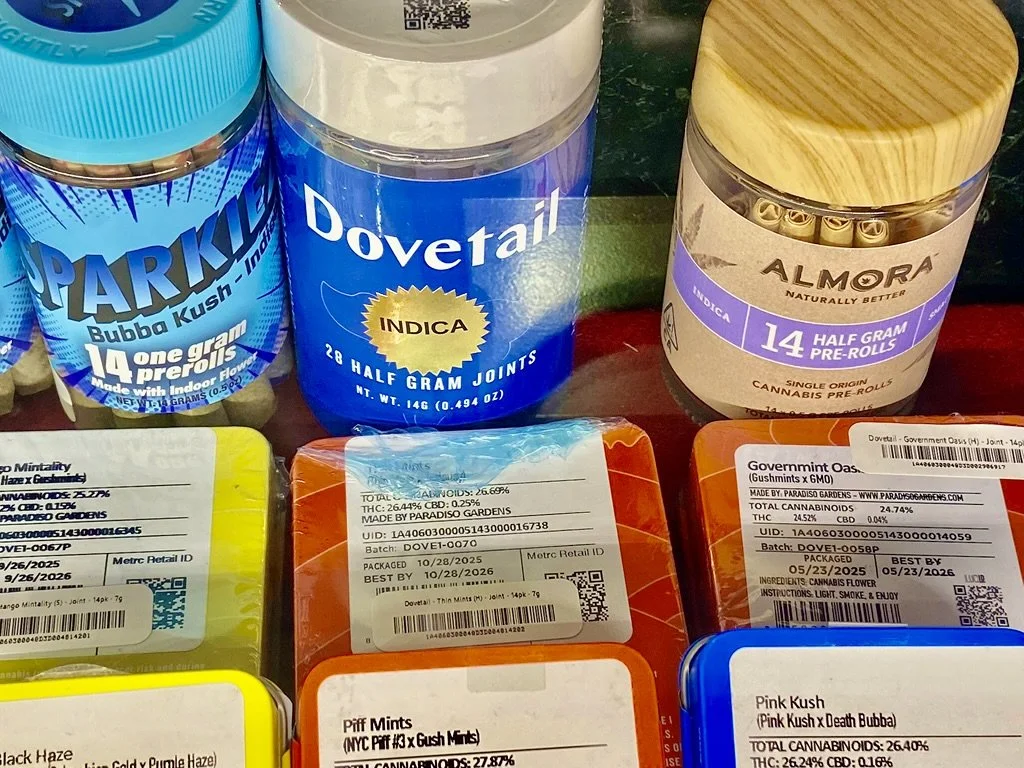
Pre-roll manufacturing has to support the variety of formats consumers actually see on dispensary shelves.
Any more chedda left? 🧀
I recently went back through some old California co-packing pricing and compared it with what the same operation is charging today. Same co-packer, four years apart. In 2022, the published labor charge to manufacture a traditional, non-infused preroll was $0.35. In 2026, it’s $0.40.
Five cents in four years. What price compression?
There are plenty of ways to look at that number, but the one that jumps out at me is the forty cents. Not forty cents for the flower, cone, packaging, testing and distribution. Forty cents in labor to manufacture one preroll. Then the preroll still has to make its way through the rest of the production and packaging process.
That number gets much more interesting when you stop thinking about a single preroll.
The Preroll Manufacturing Cost Hiding in Plain Sight
The 2026 co-packer pricing puts a traditional single preroll at $0.83 in labor once it is manufactured, put into a container, labeled, tamper sealed, post-test labeled and packed into a case. A traditional five-pack is $2.48 in co-packing labor. Again, these are labor charges. They don’t include the cannabis, cone or packaging materials.
The individual packaging touch points are interesting. A dime to put the preroll into a container. A dime to apply a label. Another dime for tamper sealing. Another dime for the post-test label. There are certainly opportunities to improve those steps, but that’s not the number I keep coming back to. It’s the $0.40 to manufacture every preroll in the first place.
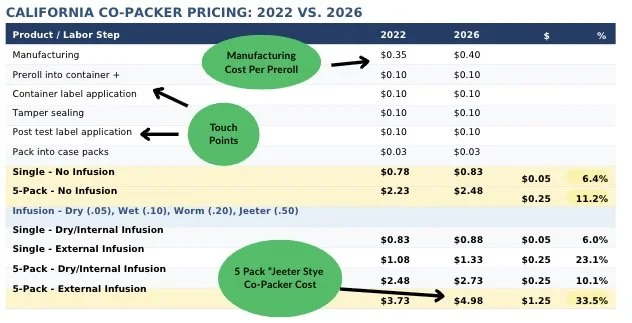
California co-packer pricing shows how labor, packaging, and additional production touch points can significantly increase pre-roll manufacturing costs.
California co-packer labor charges, 2022 vs. 2026. These figures represent manufacturing and packaging labor, not total product COGS.
Once you start multiplying forty cents across production volume, the economics become much easier to see. At 100,000 prerolls, you’re talking about $40,000 in manufacturing labor. At one million, it’s $400,000. At five million, it’s $2 million.
Now multiply it inside a package. At forty cents per preroll, there is $2.00 of manufacturing labor in a five-pack before the rest of the labor, materials and product costs. A 10-pack carries $4.00. A 20-pack carries $8.00. Get to a 28-pack and you’re at $11.20 just to manufacture the prerolls.
That starts to make me ask a different question.
Where Are All the Big Multipacks?
Walk into a California dispensary and singles and five-packs aren’t hard to find. But where are all the 14-packs? The 20-packs? The 28-packs?
Maybe California consumers simply don’t want them. Sus.
I’ve spent a long time around California preroll manufacturing, and I think there is another part of the answer. A lot of the production infrastructure in this market was built around Knockbox-style cone filling and the labor model that developed around it. That worked when the preroll category was younger, prices were different and putting five joints in a package felt like a multipack.
But the market changed. The problem with a per-unit manufacturing cost is that it doesn’t care how many prerolls you put in the package. Every additional preroll brings another manufacturing cost with it. If the underlying workflow requires forty cents of labor to manufacture a preroll, putting more prerolls in a package doesn’t magically make that forty cents disappear.
So maybe the question isn’t why we don’t have more big multipacks. Maybe it’s what would multipack economics look like if the preroll itself were dramatically cheaper to manufacture?
What Happens When $0.40 Becomes $0.04?
This is where my perspective is obviously different. We build preroll manufacturing equipment, but before that we were preroll operators. We tend to look at equipment from the production floor backward rather than from the machine spec sheet forward.
With the Hummingbird workflow, we can manufacture prerolls at under five cents of labor per unit, with four cents or less being achievable depending on labor rate, product and production volume.
That changes the math. At forty cents of manufacturing labor, a 10-pack carries $4.00 just to manufacture the ten prerolls. At four cents, it’s $0.40. A 20-pack goes from $8.00 to $0.80. A 28-pack goes from $11.20 to $1.12.
That’s not shaving a nickel off a process. That’s changing the underlying economics of the product.
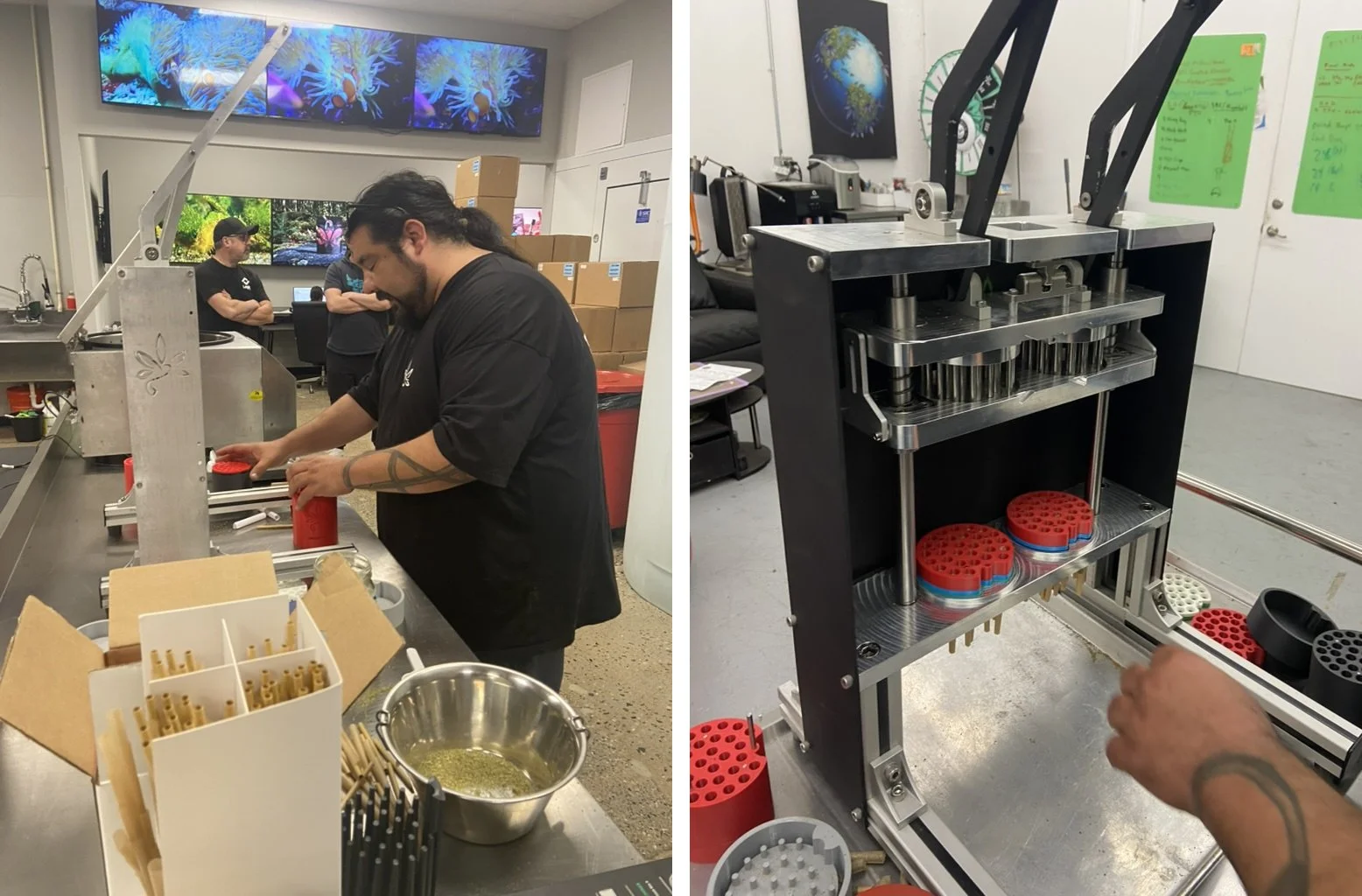
A hands-on look at the Hummingbird Workflow in a real production environment.
Production labor per preroll depends on crew size, labor rate, product and actual throughput.
And that’s why I don’t particularly care when someone tells me that Machine A makes X thousand prerolls per hour and Machine B makes some bigger number. Units per hour by itself doesn’t tell me what I need to know.
Tell me how many people I need. Tell me how many finished, sellable prerolls that crew produces in a shift. Tell me how many times somebody has to touch the product. Tell me what happens when I change from a half-gram Dogwalker to a 1-gram preroll, an infused product or a blunt tube. Then tell me what each finished preroll costs me in labor.
Now we’re talking about automation.
Preroll Machine ROI Is a Labor Calculation
This is also why I think the way we talk about preroll machine cost is often backwards. The first question shouldn’t be whether a machine costs $15,000, $25,000, $50,000 or $150,000. The first question should be what the current process is costing you.
If you’re paying forty cents of manufacturing labor and a different workflow gets that number to four cents, you’re looking at a theoretical difference of thirty-six cents per preroll before considering equipment cost and the other operating assumptions. At 100,000 prerolls, that’s $36,000. At one million, it’s $360,000. At five million, it’s $1.8 million.
Obviously, no operator should buy equipment based on somebody else’s labor calculation. Put in your wages. Put in your actual crew size. Put in your actual production. Include downtime, changeovers, cleaning and the realities of your facility. If your numbers don’t work, they don’t work. But do the math, because once the math works, the conversation about what a preroll machine costs becomes a very different conversation.
Price Compression Isn’t the Only Lever
Everyone in cannabis talks about price compression, and for good reason. But an operator can’t decide tomorrow that wholesale cannabis prices are going back up. A manufacturer can’t dictate what a retailer will charge or what a consumer is willing to pay. What we can control is how efficiently we make the product.
That’s what I see when I look at this little co-packer price sheet. Yes, labor went from $0.35 to $0.40 in four years. Yes, most of the individual packaging touches are still around a dime. And yes, externally infused products have become considerably more expensive to co-pack.
But the number I keep circling is still forty cents.
Because if forty cents can become four cents, we’re not just talking about saving money on today’s preroll. We may be talking about making products that didn’t make economic sense under yesterday’s manufacturing model.
Maybe consumers don’t want bigger multipacks. Or maybe we just haven’t made them cheaply enough yet.
Want to Run Your Own Numbers?
Download the Hummingbird Preroll Operator’s Guide for more production benchmarks, equipment-buying considerations and practical ways to evaluate preroll automation, or use our ROI Calculator to compare your current manufacturing labor with an automated workflow.
